
Machine
Sports Tutor Tennis Tutor ProLite Plus
Adds spin to ProLite.
Confirm the selected package, accessories and seller on Amazon.
Check Amazon offer ↗Read the model guideProLite and ProLite Plus are easy to mistake for a straightforward good-and-better pairing. The tradeoff is more specific: Plus adds spin capability and a larger battery, while the ordinary ProLite has a lighter published battery-equipped weight and holds more balls. The right choice depends on which limitation would affect your sessions first.
As an Amazon Associate I earn from qualifying purchases. About affiliate links.
Machine
Adds spin to ProLite.
Confirm the selected package, accessories and seller on Amazon.
Check Amazon offer ↗Read the model guide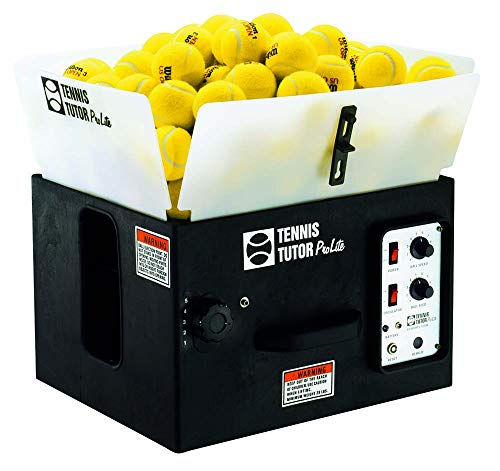
Machine
125-ball hopper and compact body.
Confirm the selected package, accessories and seller on Amazon.
Check Amazon offer ↗Read the model guide| Decision | Sports Tutor Tennis Tutor ProLite | Sports Tutor Tennis Tutor ProLite Plus |
|---|---|---|
| Battery-model lift | 27lb basic;29lb oscillating | 38lb |
| Hopper capacity | 125 | 110 |
| Training emphasis | Flat feeds | Spin variation |
| Naming risk | Basic versus oscillator version | Do not borrow Ultra/Player features |
The model chart lists ProLite at 27 lb in basic battery form or 29 lb with oscillation, both holding 125 balls. ProLite Plus is 38 lb with a 110-ball hopper. Its speed ceiling rises from 70 to 75 mph, but spin is the more substantive change.
That means the Plus is not a universal upgrade in every dimension. If lifting is already difficult, extra shot variety comes with a real transport consequence. If handling spin is the purpose of practice, the lower carry weight may be less persuasive.
A repeatable flat ball is useful when isolating a movement. Introducing topspin or underspin lets you examine whether that movement adapts to a different incoming bounce. The benefit depends on deliberately changing the exercise rather than merely making the feed harder.
The official ProLite Plus store listing confirms a switch for topspin and underspin and an included random oscillator. Match the current control panel to the exact offer. An older used Plus need not be assumed identical to every current listing.
The same manufacturer page also discusses ProLite Ultra and ProLite Player. Features described in those sections do not automatically belong to ProLite Plus. In particular, electronic elevation, preset routines and Player Mode require exact-model checking.
Write down the functions you require and match each one to the selected model. This is especially useful when a retailer shortens a title to 'ProLite' while the photograph shows a different panel. A recognizable family name is not a full specification.
As an Amazon Associate I earn from qualifying purchases. About affiliate links.
Machine
Adds spin to ProLite.
Confirm the selected package, accessories and seller on Amazon.
Check Amazon offer ↗Read the model guideMachine
125-ball hopper and compact body.
Confirm the selected package, accessories and seller on Amazon.
Check Amazon offer ↗Read the model guideChoose ProLite when carrying ease and a larger basket support your preferred flat-ball practice. Choose Plus when spin adjustment justifies its heavier body and smaller hopper. If you want complex routines, first verify whether either of these two configurations actually meets that need.
Also match the ProLite oscillator configuration: the model chart distinguishes basic and oscillating versions despite less precise wording on the family page. Compare battery versions with battery versions, since AC-only weights are lower. Once those details are resolved, a practical choice becomes easier than the branding suggests.
As an Amazon Associate I earn from qualifying purchases. About affiliate links.
Machine
Adds spin to ProLite.
Confirm the selected package, accessories and seller on Amazon.
Check Amazon offer ↗Read the model guideMachine
125-ball hopper and compact body.
Confirm the selected package, accessories and seller on Amazon.
Check Amazon offer ↗Read the model guideFind a machine · Plan your complete setup · Tennis ball machine homepage